Grand Central Park is one of the most ambitious master-planned communities in the greater Houston metropolitan area. Spanning 2,046 acres in Conroe, Texas just five miles north of The Woodlands along Interstate 45 Grand Central Park was developed on the former site of Camp Strake, a storied Boy Scout camp that operated for more than seven decades. Today, this Johnson Development Corp. community is home to thousands of residents drawn by its lush forested landscape, expansive lakes, resort-style amenities, and proximity to major employment corridors including Houston’s Energy Corridor and the Exxon Mobil campus.
With approximately 800 acres under active residential development and hundreds of new homes under construction at any given time, Grand Central Park represents a vibrant, evolving built environment. It is within this context that the work of a Demolition Contractor Grand Central Park becomes relevant not just for clearing land, but for supporting the renovation, modification, and improvement of existing structures as the community matures.
What Does a Demolition Contractor Do in a Master-Planned Community?
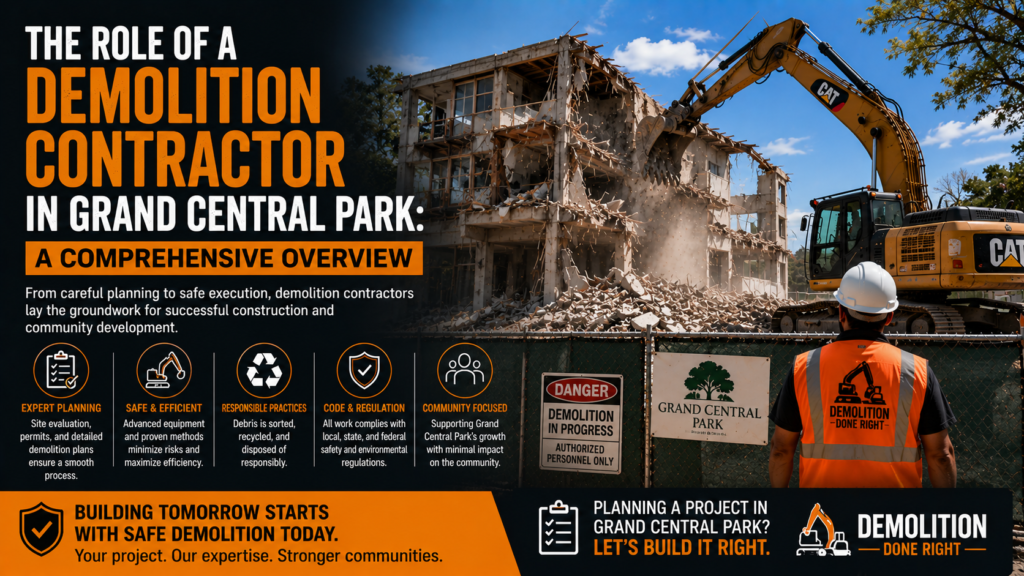
Demolition contractors serve a vital function in any active development community like Grand Central Park. Their work spans a spectrum of services that support both new construction and the improvement of existing properties. At the most fundamental level, a demolition contractor is responsible for the controlled, safe removal of structures or structural components a task that requires specialized equipment, technical expertise, environmental awareness, and regulatory compliance.
In a community like Grand Central Park, which continues to add new phases and sections, demolition contractors may be involved in land clearing and site preparation removing trees, stumps, existing structures, and surface features to prepare raw land for foundation work. They may also be engaged in the demolition of outdated or damaged structures, the reconfiguration of existing homes, or the targeted removal of specific elements like garages, outbuildings, or concrete improvements.
Selective Demolition vs. Total Demolition
Two core approaches define demolition work in residential communities: total demolition and selective demolition. Understanding the difference helps property owners make informed decisions about their projects.
Total demolition involves the complete removal of a structure down to ground level. This is typically required when a building is beyond repair, when land is being repurposed for an entirely different use, or when a structure poses a safety hazard. In Grand Central Park, total demolition might apply to outbuildings, older accessory structures, or properties that have sustained significant damage.
Selective demolition sometimes called partial demolition or a targeted strip-out involves removing only specific portions of a structure while leaving the remainder intact and structurally sound. This approach is commonly used in home renovation projects where homeowners want to open floor plans, expand living spaces, update kitchens or bathrooms, or add new architectural features. In a community like Grand Central Park where homes are relatively new but owners may already be customizing them, selective demolition is a frequently requested service.
Site Preparation and Land Clearing in Active Communities
Montgomery County, Texas, and the broader Conroe area have experienced explosive growth in recent years, driven by population migration from urban Houston and a strong regional economy. Grand Central Park sits at the heart of this growth, with new sections of the community regularly opening for development. Demolition contractors play a key role in site preparation the process of readying raw or previously developed land for new construction.
Site preparation through demolition can involve removing existing structures or concrete improvements, grubbing tree stumps and root systems, demolishing underground storage tanks or utility infrastructure, and clearing construction debris left from previous phases of development. This foundational work ensures that builders can begin new construction on stable, unencumbered ground.
Hazardous Material Considerations in Demolition
Even in newer communities, hazardous materials can be a concern. Older structures predating modern construction standards may contain asbestos in floor tiles, ceiling tiles, pipe insulation, or roof materials. Lead-based paint may be present in older homes or structures. Underground storage tanks used for fuel or chemicals may be discovered during site work. Demolition contractors working in Texas must comply with state and federal regulations governing the identification, abatement, and disposal of these materials.
A reputable demolition contractor in Grand Central Park will conduct pre-demolition environmental assessments and coordinate with licensed abatement specialists when hazardous materials are identified. This not only protects the health and safety of workers and residents but also ensures legal compliance throughout the demolition process.
The Demolition Process Step by Step
Understanding how demolition unfolds helps property owners and developers prepare for what to expect. While every project is unique, a typical demolition process follows a recognizable sequence. The process begins with a site assessment, during which the demolition contractor evaluates the structure, access routes, soil conditions, neighboring properties, and any potential hazards. This assessment informs the demolition plan and equipment selection.
Permits are secured from the relevant municipal authorities in this case, the City of Conroe and Montgomery County before work begins. Utility disconnections are arranged with gas, electricity, and water providers. If hazardous materials are present, abatement occurs first. The actual demolition then proceeds using appropriate methods and equipment, followed by debris removal and site cleanup. A final inspection confirms that the site meets specifications for the next phase of work.
Environmental Responsibility in Demolition
Texas has an increasingly strong framework for construction and demolition waste management. Modern demolition contractors prioritize the recycling and repurposing of demolition materials. Concrete is crushed into recyclable aggregate. Steel and metal components are salvaged for scrap. Wood materials may be diverted for reuse or biomass applications. This commitment to material recycling reduces the environmental footprint of demolition projects and aligns with the sustainability values increasingly embraced by master-planned communities like Grand Central Park.
Why Demolition Expertise Matters in Growing Communities
In a rapidly growing community like Grand Central Park, the quality and professionalism of demolition work have far-reaching consequences. Poor or careless demolition can damage adjacent structures, disrupt utility infrastructure, introduce dust and debris into the environment, and create safety hazards for workers and residents. Conversely, skilled, well-planned demolition work creates a stable foundation for everything that follows setting up new construction and renovation projects for success.
Conclusion
Grand Central Park is a community built around a vision of quality, natural beauty, and thoughtful development. Demolition contractors who work in and around this Montgomery County gem share in that vision by providing services that are technically precise, environmentally responsible, and safety-focused. Whether clearing a site for new construction, performing targeted interior demolition for a home renovation, or managing the careful removal of structural elements, demolition contractors are a vital part of the construction ecosystem that continues to shape Grand Central Park’s remarkable growth story.